
What Is It Like Living in Eagan, Minnesota?
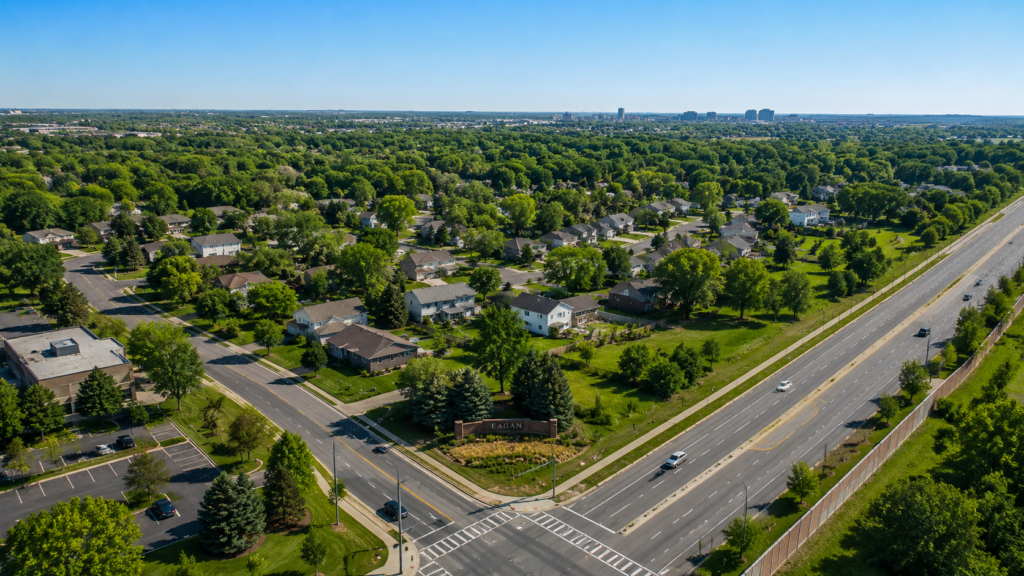
A woman from Atlanta called me last February after accepting a position with a healthcare company headquartered in the southern Twin Cities metro. She had three weeks before she needed to be on-site for her first day. She had a budget, a general sense of what she wanted, and zero familiarity with any of the communities in the metro. Her hiring manager had mentioned Eagan as a place worth looking at. Her coworker had mentioned Apple Valley. Someone else had suggested Burnsville. She called me and said something that I think reflects exactly how most people approaching a new metro feel. “I don’t even know what questions to ask yet. Can you just tell me what Eagan is actually like to live in?” That question, asked honestly and without pretense, is one I find genuinely satisfying to answer because Eagan is a community I know well and one that rewards a thorough description rather than a generic summary. Here is what Eagan is actually like to live in. The Basic Geography and Setting Eagan sits in Dakota County in the southern Twin Cities metro, directly south of Saint Paul and southeast of Minneapolis. It borders the Minnesota River to the southwest, which contributes to some of the most genuinely scenic natural areas in the first-ring and second-ring suburban landscape. It is bounded by Burnsville to the west, Apple Valley to the south, and Inver Grove Heights to the east. The city developed primarily from the 1970s through the 1990s, which means most of its housing stock falls in that age range. There is newer construction in specific pockets, particularly along the eastern and northern edges of the city, but Eagan is not a community where new construction communities dominate the landscape the way they do in outer-ring suburbs like Lakeville or Woodbury. The topography of Eagan is more varied than many people expect from a Minnesota suburb. The Minnesota River bluffs create genuine elevation change in the western and southwestern parts of the city, and the community has a significant amount of mature tree cover that gives established neighborhoods a warmth and enclosure that newer suburbs often lack. The Employment Landscape One of Eagan’s most distinctive characteristics is its position as a significant employment center in its own right, not just a bedroom community for Minneapolis and Saint Paul. Eagan is home to a substantial corporate presence. Blue Cross Blue Shield of Minnesota, Thomson Reuters, Unison Technologies, Delta Air Lines reservations and technology operations, and numerous other companies have significant operations in Eagan. The city also has one of the largest business park environments in the metro, including the Eagandale Center Industrial Park, which generates significant employment across sectors including technology, financial services, logistics, and manufacturing. For residents who work within Eagan or in the nearby Mendota Heights and Bloomington employment corridors, the community offers the genuinely rare combination of suburban residential life and a short reverse commute to employment rather than the longer drive into Minneapolis or Saint Paul that characterizes much of the southern metro. For residents commuting to Minneapolis or Saint Paul, Eagan’s position along Interstate 35E and Interstate 35W, which split north of the city, provides two highway corridors that connect to both city cores. Rush hour on these routes can be significant, but the directness of the connection and the relatively short distance to downtown Saint Paul in particular make the commute manageable for many residents. The Neighborhoods and Housing Eagan’s housing landscape reflects its development era. The primary residential inventory consists of single-family homes built in the 1970s through the 1990s, with mature landscaping, established neighborhood infrastructure, and the particular character that comes from housing that has been inhabited and maintained through multiple generations of ownership. Price points in Eagan have historically been accessible relative to some neighboring communities. While prices have risen meaningfully over the past several years as they have throughout the metro, Eagan generally offers more square footage and lot size for the money than comparable communities to the north and west of the city. There are also substantial condo and townhome communities in Eagan, particularly along major commercial corridors and near employment centers. These offer an accessible entry point for first-time buyers and an attractive option for residents who want the suburban location without the single-family home maintenance responsibility. Specific neighborhoods within Eagan worth knowing include Lexington Diffley, which is known for its accessibility to parks and trails, the Cedar Grove area near the southwestern part of the city which has seen significant reinvestment and commercial development in recent years, and the neighborhoods near Thomas Lake and Blackhawk Lake which offer the proximity to natural amenities that make some Eagan addresses particularly desirable. The Parks and Outdoor Life Eagan’s park system is one of the most significant quality-of-life assets the community offers, and it is frequently cited by residents as a primary reason they chose to stay rather than move as their family situations changed. The city has over 3,500 acres of parks and open space, which is a genuinely extraordinary amount for a fully developed suburban community of its size. Blackhawk Park, Thomas Lake Park, Moonshine Park, and the Lebanon Hills Regional Park, which sits partly within Eagan’s borders, collectively offer residents access to trails, lake swimming, fishing, picnic areas, and natural areas of genuine quality. The Minnesota River bluffs create access to river valley trails and natural areas that feel meaningfully different from typical suburban park infrastructure. The overlooks along the bluff trail system provide views of the river valley that remind residents that they are in a place with genuine natural character rather than simply a developed landscape with some landscaped green space. For residents with an active outdoor lifestyle, Eagan is one of the better-positioned southern metro communities for meeting that need without leaving the city limits on most days. The Schools Eagan is served primarily by Independent School District 197, West Saint Paul-Mendota Heights-Eagan, and by Independent School District 196, Rosemount-Apple Valley-Eagan, with the