2026-07-17 · 4 min read · Minnesota
What Is It Like Living in Eagan, Minnesota?
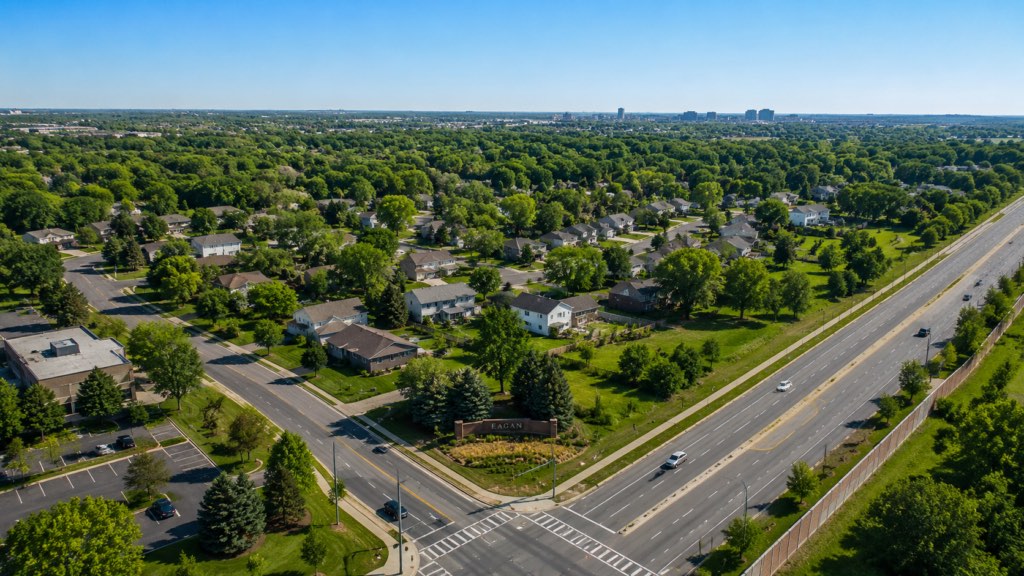
What is it like living in Eagan, Minnesota? Eagan is a city of rolling hills and mature trees in Dakota County, an equal distance south of downtown Minneapolis and downtown St. Paul, with the Minneapolis-St. Paul International Airport just across the Minnesota River. It has more than 1,300 acres of city parkland, more than 150 miles of trails and sidewalks, and much of the almost 2,000-acre Lebanon Hills Regional Park. Two interstates and several state highways run through the city, so most daily trips are short drives.
Where is Eagan, and how big is it?
- Population: 68,855 at the 2020 census and an estimated 67,109 on July 1, 2025, according to U.S. Census QuickFacts. It is the second-largest city in Dakota County.
- Land: about 31.2 square miles.
- ZIP codes: 55121, 55122 and 55123.
- Water: roughly 1,200 lakes, ponds and wetlands.
What does a typical week look like in Eagan?
Daily life in Eagan centers on a few busy areas and a lot of green space between them.
- Central Commons. The city's name for an 862-acre area around Pilot Knob Road, Yankee Doodle Road and Interstate 35E. It includes Eagan Town Centre, the Eagan Promenade and Central Park Commons for shopping and dining. See our Central Commons page.
- Central Park. At 1501 Central Parkway, with the Eagan Community Center, festival grounds, a splash pad, a band shell and The Blast, a multi-level indoor playground.
- Cedar Grove. A redevelopment area in western Eagan along Cedar Avenue and Highway 13, where the Twin Cities Premium Outlets opened in August 2014.
- Viking Lakes. A 200-acre mixed-use area in northeast Eagan with the Minnesota Vikings headquarters and newer apartment and townhome plans.
What is there to do outside in Eagan?
- Lebanon Hills Regional Park. The largest park in the Dakota County system, almost 2,000 acres of trails and lakes, with a visitor center at 860 Cliff Road.
- Cascade Bay. The city's outdoor waterpark, with seven waterslides, a lazy river and mini-golf.
- Eagan Civic Arena. Two indoor, regulation-size ice sheets with skating year-round.
- City parks. Holz Farm, a tubing hill, an archery range, a bike park, disc golf and a skate park.
The city also cares for its many lakes, ponds and wetlands and works to protect and improve fishing on them.
How do people get around from Eagan?
Interstate 35E and Interstate 494 both run through Eagan, along with Highway 13, Highway 55, Highway 77 (Cedar Avenue) and Highway 149. The airport is just across the Minnesota River.
Transit options include MVTA express buses to Minneapolis and St. Paul from the Eagan Transit Station at 3470 Pilot Knob Road and the Blackhawk Park and Ride. The Cedar Grove Transit Station connects to the METRO Red Line, which runs between Apple Valley and the Mall of America.
Where a home sits makes a real difference in your drive. We look at your daily route before you choose a part of the city.
How did Eagan grow, and what kinds of homes are there?
Long before the township, the Black Dog village stood on the shore of the Minnesota River. Eagan Township was established in 1860 and named for Patrick Eagan, its first Town Board Supervisor. For decades the area was farmland. Between about 1840 and 1930 it was known for its onion farms Eagan incorporated as a city in 1974 and grew from 20,700 people in 1980 to 63,557 in 2000, and much of its housing was built in that stretch.
Today the city has nearly 30,000 housing units, from single-family homes to townhomes and apartments. In the Census survey for 2020 to 2024, the median value of an owner-occupied home was $397,100, and 67.7 percent of occupied homes were owner-occupied. That is a survey figure, not today's sale prices.
What services will you set up?
- Water and sewer. Provided by the city.
- Electric and gas. Dakota Electric serves most homes, with Xcel Energy in some areas. Natural gas comes from Minnesota Energy Resources or CenterPoint Energy, depending on location.
- Trash. The city does not provide garbage service. You choose a city-licensed hauler, and every licensed hauler must offer curbside recycling.
- Library. Wescott Library, a Dakota County Library branch, is at 1340 Wescott Road.
- Schools. Three districts serve parts of Eagan: ISD 196, ISD 197 and ISD 191. Confirm the district for each address.
Where can you read more about Eagan?
If you want the trade-offs side by side, read our pros and cons of living in Eagan. If you are getting ready to buy, our guide on what to know before buying in Eagan in 2026 walks through the checks. The full city profile is on our Eagan area page.
Frequently asked questions
Where is Eagan, Minnesota?
Eagan is in Dakota County, south of downtown Minneapolis and St. Paul and an equal distance from each. The airport is just across the Minnesota River.
How many parks does Eagan have?
The city has more than 1,300 acres of parkland and more than 150 miles of trails and sidewalks. Lebanon Hills Regional Park, almost 2,000 acres, is partly in Eagan.
Is there public transit in Eagan?
Yes. MVTA runs express buses from the Eagan Transit Station and the Blackhawk Park and Ride, and the Cedar Grove Transit Station connects to the METRO Red Line.
When did Eagan become a city?
Eagan Township was established in 1860, and Eagan incorporated as a city in 1974.
Curious about a part of Eagan? Send us a message or call (651) 661-4770. What questions do you have?